
Smart Cities, Habitat III and the New Urban Agenda

Smart Cities, Habitat III and the New Urban Agenda by Ines Renique

Urbanization has been growing at exponential speeds, and Habitat III was a recent conference that addressed just that. Cities are growing and changing at levels that often states cannot keep up with. And considering cities make up about half of the worlds population, maintaining quality infrastructure, services and order is fundamental. Moreover a major issue needed to be addressed in order to create smart cities, is that of slums as well. I was recently in Sao Paolo, Brazil, the largest metropolitan city in the world. And there it was shocking to see the stark differences in society. As for example, right next to the most expensive and luxurious shopping mall filled with handbags and shoes costing thousands of dollars, was one of the largest “favelas” in the city.

Situations like these are exactly what was addressed in Habitat III and in the development of smart cities.Habitat III was an inclusive conference that allowed for people from around the world to participate virtually, even though the conference was in Quito, Ecuador. The deliverables from Habitat III would then be the New Urban Agenda.

Furthermore, the representation of many groups is imperative, since all have the “Right to the City”, as cities need to be inclusive. That is why Habitat III sets the agenda for 20 years on inclusive sustainable development of housing/infrastructure. And when doing so, includes major groups in the decision making process, such as indigenous people, local authorities, trade unions, women, children, aging and the elderly, among others. Furthermore, the New Urban Agenda makes 15 references to people with disabilities. And new technologies, such as the app piloted by the IDPP, work to further the inclusion of people with disabilities in new, smart cities.
ICTs and Inclusive Sustainable Development

ICTs and Inclusive Sustainable Development by Ines Renique

WSIS and WSIS+10 are working to narrow the digital divide. Furthermore, resources such as the SDG and WSIS matrix, allow greater access and points of comparison between the two important frameworks.

What I most investigated for my project was, how is that WSIS can promote education in remote areas. What I found was that the WSIS proposals of E-Business and E-Agriculture are taking advantage of ICTs to expand education outreach. As outlined in WSIS Action Line C7,  “E-learning can play an important role in making education accessible at any time and from any location, which will be particularly important for groups with little time and little flexibility to attend remote trainings.”

Many of the WSIS Action Lines, served as inspiration for me when thinking of the deliverable I wanted for my final project. Ultimately what I created was a platform but online and via phone apps that serve for students and teachers to share their thoughts on the education system in Peru.

And much of that project was inspired by the part of the WSIS+10 outcome document that puts its goals simply by saying:

“We reaffirm our common desire and commitment to the WSIS vision to build a people­ centered, inclusive and development ­oriented Information Society, where everyone can create, access, utilize and share information and knowledge, enabling individuals, communities and peoples to achieve their full potential in promoting their sustainable development and improving their quality of life, premised on the purposes and principles of the Charter of the United Nations, and respecting fully and upholding the Universal Declaration of Human Rights.”

While that paragraph is only a small portion of the WSIS+10 document, I see it as the summation of the major idea behind it. Overall advancing the opportunities of people, and ensuring equality through access to ICTs, and ensuring their rights are met. While it sounds idealistic, WSIS+10 then goes into great detail as to how these goals can actually be accomplished. Moreover, as mentioned in other blog posts, accountability from states is essential to uphold the goals outlined.  That is why it was important to follow up on WSIS with WSIS+10, and continue to have task forces committed to promoting the values and conclusions from the WSIS meetings, within their own states.

The Digital Divide

screen-shot-2016-12-09-at-11-19-16-am

The Digital Divide by Ines Renique

Falling Through the Net was a report that meticulously addressed the divide between urban and rural parts of the country, and between access to ICTs. Moreover, my final project greatly focuses on the digital divide, trying to narrow the disparity between the rural and urban parts of Peru.

And while my project is centered internationally, there are many divides within the United States as well. As The White House website explains:

“The benefits of this technological revolution, however,

have not been evenly distributed. Millions of Americans

still do not regularly use a computer, and research shows

that there remain substantial disparities in both Internet

use and the quality of access. This “digital divide” is

concentrated among older, less educated, and less

affluent populations, as well as in rural parts of the

country that tend to have fewer choices and slower

connections.”

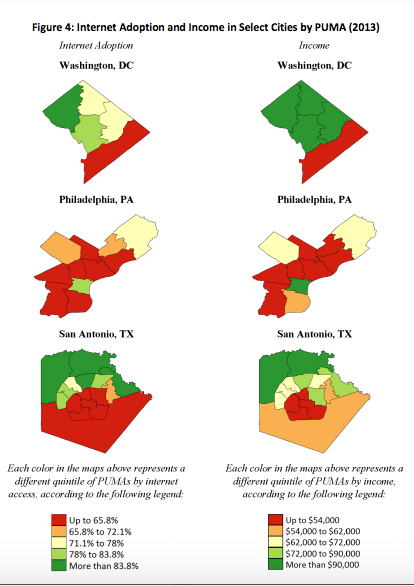
The United States is supposed to set the standard for under developed nations, however, the U.S still has problems of its own when it comes to disparities. The lack of ICTs directly correlates with lower income. This is demonstrated in the image above from https://www.whitehouse.gov/sites/default/files/wh_digital_divide_issue_brief.pdf 

This image highlights the fact that the specific areas in cities and towns with low income rates, also have low internet rates. This is a nationwide phenomenon, therefore, it is areas of low income that most need to be targeted when trying to expand ICT access.

Moreover, the the issue transcends just access to ICTs. The quality of said access is important. What point is there to having an internet router, if the connect does not work.

In regards to worldwide access to ICTs, The MacBride Commission report centered on the disparities between developing and developed countries. This report discusses the lack of democratization in ICTs in some nations.

It must be noted that the two reports mentioned are rather outdated. But, unfortunately, many of the issues outlined in the reports are still problems today.

Stakeholders in the SDGs and HLPF

The Sustainable Development Goals define themselves on the official United Nations website as an official agenda intended to serve as a “plan of action for people, planet and prosperity”. The seventeen Sustainable Development Goals and 169 targets, which the UN has announced, demonstrate the scale and ambition of this new universal Agenda. It also seeks to improve the reach and quality of peace through many kinds of enhanced freedoms. The makers of the Goals note in that eliminating poverty is the “greatest global challenge and an indispensable requirement for sustainable development”. Similarly lofty goals in the Goals are the elimination of violence and bringing perfect access to justice for every person in every country. The Goals seek to build on the Millennium Development Goals and to bring into existence what the MDGs worked for. The Goals advertise themselves are integrated and inseparable in that they balance the three dimensions of sustainable development: the economic, social and environmental.

The Goals count every country as a stakeholder and also frequently refer to “all stakeholders” as an umbrella group. The stakeholders are those entities that will collaborate to implement the SDGs. This implies that even if everyone’s input is not equally heard, everyone will have a voice in the satisfaction of these goals. The meeting of the high-level political forum (HLPF) on sustainable development in 2017 convened under the authority of the Economic and Social Council from Monday, 10 July, to Wednesday, 19 July 2017 as the first attempt to integrate the countless voices that the SDGs purport to need. Many of the other posts on this blog go into considerable depth on the details of the HLPF, so this post will explore a pessimistic, tangentially related idea. The HLPF has scheduled meetings from this year to the year 2030. 2030 is the deadline that the SDGs have given themselves. The HLPF’s official website says that its most frequently employed review mechanism will be to encourage member states to “conduct regular and inclusive reviews of progress at the national and sub-national levels, which are country-led and country-driven” (paragraph 79)”. The site says that these national reviews are expected to serve as a basis for the regular reviews conducted by the (HLPF). As written by the 2030 Agenda, “regular reviews by the HLPF are to be voluntary, state-led, undertaken by both developed and developing countries, and involve multiple stakeholders”. This initially sounds positive, but the intentionally expansive definition of “stakeholders” could allow the accounts and opinions of local-level bureaucrat’s to be the false global perception of a development issue in a remote region.

Grand Challenges of Today

Grand Challenges of Today

The Grand Challenges are felt by every nation, as they are the most pressing global issues that need to be addressed by policy makers, thinkers, stakeholders and citizens. The issue of the global grand challenges transcends the public and private sector. The White House site adds to this by saying that “In addition to Federal investments, there are a growing number of companies, foundations, philanthropists, and research universities that are interested in pursuing Grand Challenges.” Highlighting some of the work done by The Gates Foundation, Google and IBM among others.

Futhermore, USAID highlights two points when looking at the grand challenges saying that:

“1) Science and technology, when applied appropriately, can have transformational effects; and

2) Engaging the world in the quest for solutions is critical to instigating breakthrough progress.”

Organizations and governments are planning for future technologies, but the grand challenges priorities vary country to country. In some nations the grand challenges may be more simple of complex than in others.

Lewis Branscomb is critical of just focusing on technological and scientific advances. He asked the question “But is this policy focus on science sufficient to the tasks at hand?” The tasks at hand being large society challenges that need to be solved.

Branscomb continues to point out that, historically, the United States government “would support academic science, engineering, and medical research, leaving the management and finance for transforming scientific discoveries into economic value to the incentives of private financial markets. By this route, the United States has built the most powerful science knowledge engine in the world.”

Looking at the past as Branscomb just did, allows one to see trends that may be repeated.

I agree with Branscomb’s points that the current science may not be enough to catch up to a rapidly changing society with many problems to be addressed.

Global Strategies & Frameworks

I once read about a Norwegian aid agency that decided  to invest in providing a village in Kenya with a fish-freezing plant. Only to find out that the people of this village raise goats. This was a useless investment that has been replicated time and time again. Bringing to question… can international “outsider” organizations impose on other nations? Do other “developed” nations really know what a “developing” nation most needs?

There is a double edged sword oftentimes when it comes to global strategies. And as the Sustainable Development Goals were only put into place a year ago, they Millennium Development Goals are a great point of reference to see what was done right and what was done wrong. Moreover these mistakes and successes can then be inspiration for the remaining years of the Sustainable Development Goals.

Task Teams are a great means of reflection. “The MDGs after 2015: Some

reflections on the possibilities” by Deepak Nayyar’s is a report with insightful points about the post 2015 development agenda.

A key point Nayyar makes, and that i have always argued when it came to the MDGs, is that “the MDGs specify an outcome but do not set out the process which would make it possible to realize the objectives. In other words, the MDGs specify a destination but do not chart the journey” (page 6 of report). Fortunately, the SDGs outline targets in more detail for each goal, which addresses the problem Nayyar points out.

Lastly, he also points of the importance of national context. That based on a country’s norms and mores, propositions and solutions need to be reformulated. Along with that is the importance of governments in making progress advance. Nayyar explains that “In rethinking development, it is important to recognize the relevance of the balance between domestic and external factors and the critical importance of public action.” Achieving that balance and fulfilling the call to action from local communities are fundamental in moving towards higher standards of life.

Grand Challenges and the Multi-Stakeholder Approach

The concept of “Grand Challenges” is manifested in both the Millennium Development Goals and the more recent Sustainable Development Goals. Both represent difficult, yet achievable challenges that our world faces. In fact, the failure to meet the Millennium Development Goal’s represents exactly how ambitious “Grand Challenges” are. They are crosscutting issues that impact individuals at global levels. These issues are manifested in international frameworks, such as the Sustainable Development Goals and the New Urban Agenda. These grand challenges are meant to mobilize resources and empower communities. However, in order to do so, goals must first be established. As Tom Kalil stated in his speech delivered to the Information Technology and Innovation Foundation, in order to tackle grand challenges, it is essential that clear goals are established. By raising this point, Kalil is making a larger assertion about the implementation of international frameworks addressing these grand challenges. Kalil asserts, “grand challenges should have measurable targets for success and timing of completion.” Because of the nature of grand challenges, these important issues not only need the attention of the international community, but also a commitment to the implementation and monitoring of these grand challenges. Without an international commitment to the implementation and monitoring of international frameworks, not much headway will be accomplished, other than acknowledging that grand challenges exist. A key example of this is in the international communities failure to meet the Millennium Development Goals by its’ deadline. The failure to meet the Millennium Development Goals fostered the understanding of the importance of implementation and monitoring mechanisms, in the efforts toward inclusive sustainable development. Another crucial step toward tackling grand challenges is in how these challenges are defined.

Interestingly enough, Lewis Branscomb, Tom Kalil, USAID, and the White House, define grand challenges in respect to scientific and technological innovation. While I do believe that technological innovation is integral, I do not believe that innovation is the sole factor. Instead, it is my opinion that both multistakeholderism and innovation are integral to tackling grand challenges. A multi-stakeholder commitment to grand challenges is essential because it brings together a variety of stakeholders that bring their respective expertise along with them, thus fostering conversation and innovation. In my opinion, bringing key stakeholders together to facilitate conversation about these global grand challenges is key, as multistakeholderism fosters innovation. However, the Lewis Branscomb, Tom Kalil, USAID, and White House sources do not take into account the importance of multistakeholderism as a means to address global grand challenges.

Habitat III, NUA, and Smart Cities

The United Nations Conference on Housing and Sustainable Urban Agenda (Habitat III) met in Quito, Ecuador in October of 2016. The two previous habitat conferences were held in 1976 and 1996 respectively. During Habitat III the New Urban Agenda (NUA) was passed. The New Urban Agenda seeks to bring about more inclusive, sustainable development to cities. While officially passed at the Habitat III conference, the majority of the writing and negotiations occurred at preparatory meetings that occurred in the lead up to the conference. Among the New Urban Agenda’s most championed ideas are those of “smart cities” and “inclusive cities” both of which strive to make cities and their amenities more accessible to all. The New Urban Agenda seeks to complete all of this in a twenty-year time frame. This means that the next Habitat conference should be held in 2036.

Smart cities represent a new way of talking about and perceiving inclusivity within cities. By using new technologies, the New Urban Agenda hopes to inspire and advocate for a more inclusive approach to urban planning and development in order to create “smart cities.” Smart cities utilize information and communication technologies (ICTs) that allow more people to utilize recourses within a given city. For example, smart bus systems allow users to check online when busses are arriving to reduce wait times outside and to allow for better trip planning.

I believe that smart cities and many of the perspectives championed by the New Urban Agenda are the future of urban development. As cities rapidly expand, the reality of mega cities and the social, political, and economic inequities that exist within them must be addressed. In today’s model of urbanization recourses are concentrated in wealthy areas while poorer areas often struggle for access to basic societal goods such as transportation and recreation/communal spaces. Beyond this, as the proportion of countries’ populations living in urban areas expands, it becomes more and more critical to address the most vulnerable groups among us. Many of concepts contained within the New Urban Agenda speak to these vulnerable groups. One group that was explored thoroughly in class was persons with disabilities. Smart city initiatives allow for great access to societal recourses and therefore more involvement in the community as a whole. However, even once smart city or inclusive initiatives are implemented within a city, it will be exceedingly important to maintain these systems and ensure their continued use.

Intersectionality in Sustainable Development

Intersectionality discusses the fact that different social identities and demographic groups cannot only be looked at in a vacuum; they are interconnected and will always be.  People identify with more than one demographic group, so when looking at how development is affecting certain groups we have to take these nuances into consideration to get a broader understanding of the situation.  Some demographics that are under examination when looking at development include race, gender, class, ethnicity, age, and more.  When looking at the interactions of multiple demographics within an individual or group, there are different outcomes and implications then if we were to only look at one.  For example, a disabled woman will face different challenges than a disabled child.  A disabled child may be excluded from receiving an education, and a disabled woman may not be able to access adequate prenatal care.

The Grand Challenges show us that participants from all these different groups need to be involved in development to help paint a more detailed picture of what the problems are, and how they can best be solved.  Stakeholder groups in international development include: Women, Children and Youth, Indigenous Peoples, Non-Governmental Organizations, Local Authorities, Workers and Trade Unions, Business and Industry, Scientific and Technological Community and Farmers.  These are the nine groups that the UN outlines in the Sustainable Development Goals, although there are many others.  Since the goals were redesigned, there has been a larger focus on paying mind to intersectionality among different stakeholder groups, and in making sure development practitioners have the opportunity to hear from many different viewpoints on what problems should be addressed.

The conceptual basis for my final capstone project on sustainable urban transport in São Paulo had a lot to do with the concept of intersectionality in development.  The recommendations I made came from multiple angles, and did not simply suggest the government expand transportation networks.  Since the issue affected urban residents in many different ways, I made recommendations that would also indirectly fix the problems seen in the city to fill in the gaps where simply building more public transit wouldn’t fix the issue.

Inclusive Education

Inclusive education is another grand challenge international development practitioners have grappled with for a long time, and universal primary education is one of the top concerns or goals to achieve for the Sustainable Development Goals.  When talking about inclusive education, a main problem we see is students with disabilities being excluded from the classroom environment.  There are many different reasons behind this. Oftentimes, people say they will promote disability-inclusive education, but it is much more difficult to do in practice, and much less common.

This can be for cultural reasons.  In many countries, students with mental or physical disabilities are stigmatized for their condition.  This certainly happens in the United States, but we have stronger protections in place for ensuring that students of different backgrounds and abilities are included, relatively speaking.  The cultural stigma of someone having a disability will lead schools to say they cannot have that student in the classroom.

Another cause behind this problem is the extremely daunting financial and professional burden of ensuring that every student, regardless of level of ability, has a seat at the table of education.  It can be extremely costly to get professionals who are trained in working with students with disabilities, and to purchase appropriate equipment and tools that may be needed for a disabled student to have the same level of success as a student who does not have a disability.  It can also be costly, for example, to make an educational facility accessible to a student with a physical disability.  These may mean building wheelchair ramps or installing elevators, which many schools to not have the funds to put in.

As previously discussed, the Millennial Development Goals did not mention these issues enough, but the CRPD has been working hard to increase the rights of people with disabilities.  The cultural stigma is tough to combat if it is so deeply ingrained in the cultural fabric of a country, but the CRPD and the new SDGs recognize the need to combat the issue from a cultural standpoint and a financial one.  Students with physical and mental disabilities have unique problems, and the tactics used also need to be tailored to the country of operation due to cultural reasons.  That way, the outcome can be as effective as possible.