
The Digital Divide(s)

These days it is difficult to imagine our world without the Internet. Since the invention of the Internet in 1989, Internet usage has increased tenfold. The Internet is now an integral part of everyday life for many individuals. While it may seem that a majority of the world has access to the Internet, this is far from the truth. For example, when conducting research for my capstone project, I discovered that out of Timor-Leste’s 1.2 million people population, a mere 14,030 individuals have access to the Internet from their homes.

While information and communications technologies (ICTs) grow rapidly, large portions of society remain largely disconnected from the Internet, thus perpetuating the digital divide. The digital divide refers to the difference in individuals who have access to information and communications technologies (ICTs) and those who do not. The digital divide describes the patterns of unequal access to information technology based on age, gender, race, ethnicity, geography, and broadband and bandwith access. The various types of digital divides have large implications in the movement toward inclusive sustainable development.

The MacBride Commission report, “Many Voices, One World,” published in 1980, under UNESCO, highlighted the imbalances between developed and developing countries in respect to information capacities, particularly relating to the media. As a result of its’ findings, UNESCO, promoted the establishment of a New World Information and Communication Order (NWICO) to address imbalances of the media and the unequal access to information and communication.

In “Falling through the Net, the National Telecommunications and Information Administration (NTIA), discovered a significant digital divide among the “haves” and the “have nots” in the United States. According to “Falling through the Net”, “Minorities, low-income persons, the less educated, and children of single-parent households, particularly when they reside in rural areas or central cities, are among the groups that lack access to information resources” in the United States. Despite the increasing prevalence of ICT’s in the United States, large disparities still exist.

The MacBride Report “Many Voices, One World,” and “Falling through the Net” emphasize the importance of equal access to ICTs. However, in bridging this gap, emphasis must not solely be placed on access to Internet, but on the capabilities of Internet access. As we spoke about in class, important considerations must include – how much information can flow through the pipe, is there access to broadband Internet, is there access to broadband remotely, and how much bandwith is available. The movement toward bridging the gap must not only focus on providing the infrastructure, but focusing on what can be done with the infrastructure provided.

In order to achieve inclusive sustainable development, it is essential that universal service of information and communications technologies be achieved. The success in achieving universal service of ICTs is dependent on innovation, investment, and multistakeholderism. For example, incentivizing the private sector to get involved in bridging the digital divide is highly important. Encouraging competition and investing resources is also vital to bridging the digital divide.
Digital Divide(s)

As we dove further into the Digital Divide, I realized that physical access to ICT’s is just one small piece of a much larger puzzle. As with most development issues there are layers of complexity. I was particularly moved by the MacBride Report and its affects. There are so many issues with the media and accessing information that the report highlighted. I was particularly struck by the United States’ reaction to the report. The US was so offended by the communication problems that the report unearthed, like the concentration and commercialization of media, that they actually left UNESCO. This reaction exposes a deep, underlying issue in the Digital Divide and why it exists. Since all media outlets are in the North, the Global South has no control over the type of information they receive through the media. They have no agency over the information that is considered important or newsworthy. And furthermore, states like the US intend to keep the divide, hence the visceral reaction to the MacBride report. This creates a huge development challenge. What good is physical access to ICT’s if the intellectual material is still dictated by another? Just because someone has physical access to computers and internet does not mean that the Digital Divide is solved.

Another issue with the Digital Divide is the skills divide and the knowledge divide. Both of these divides highlight the continued commitment that needs to be made to truly bridge the gap between those who have access to technology and those who do not. If you do not know how to use the technology, then the skills divide will prevent you from accessing any information at all. Furthermore, if information is not available in your language, or reflects your political views, interests etc., then technology is not really accessible to you either. Technology should provide the opportunity for all to thrive and be connected. However, if you cannot access information that is relevant to you, then all the technology in the world is useless to you. This is a huge challenge for solving the Digital Divide, especially with languages. As more and more people gain access to technology, it will have to be adapted in more languages. It is not just the keypad or interfaces that needs to adjust, but the information itself. If there is no online content in your language, then the physical technology holds no purpose. The complexity of the Digital Divide goes far beyond physical access to ICT’s and it will take a lot of innovation and investment from the international community to solve this divide.

Digital Divide(s)

The term “Digital Divide” refers to the concept of a division in access to certain technologies that prevents communication and at times, further development with a community or country. Depending on the source utilized there can be one digital dived or multiple digital divides. Most of the discussed digital divides center upon demographical separations both domestically and internationally. These separations often occur along age, income, and geographical location divides. The presence of digital divides presents a large problem in our continuously globalizing society. Predictably, there are a number of different reports written on the subject.

This phenomenon of digital divides was explored thoroughly in the 1995 report titled, “Falling Through The Net.” The report, published by the United States National Telecommunications and Information Administration explores the digital divides that exist within the United States. Some of the most prominent divides found were between age and geographical location. The report is considered a key perspective in the discussion on ICTs and digital divides. However, “Falling Through the Net” was not the only report released that touched on the concept of digital divides. The 1981 report titled, “Many Voices, One World” explored similar topics. The report was published by the United Nations Educational Scientific and Cultural Organization (UNESCO) and is often referred to as the McBride Report. Chapter 6 specifically of Part II of the report explores the disparities in communication technologies. It also expresses the need to address these disparities. These two reports, “Many Voices, One Voice” and “Falling Through the Net” brought attention to the concept of a digital divide (or multiple digital divides) to the attention of the international community. They also facilitated the initial attempts to address the existence of digital divides and the various repercussions of their existence.

As stated previously, addressing digital divides is essential in an increasingly globalized society. As discussed in the two previous classes, ICTs are critical to developing more inclusive urban areas and the inclusive, sustainable development of society as a whole. In fact, many of the goals and ideals set forth in the New Urban Agenda will be exceedingly difficult to address should these digital divides persist. Therefore, it can be argued that the very existence of digital divides makes sustainable, inclusive development exceedingly difficult. Similar opinions, as is noted by Megan as well, are expressed in other documents associated with this class including the WISIS +10 outcome document and the WISIS +10 matrix. Looking into the future, addressing digital divides will be essential if the international community hopes to achieve true inclusive and sustainable development.

Digital “access” Divide

When I think of the digital divide, the first word that comes to mind is “access.” The digital divide refers to the existing gap between those who can access the internet and those who can’t. Internet access is one of the many resource that people in industrially developed areas take for granted. I think I can speak for my fellow college students (and probably most of our parents) when I say we get frustrated with slow internet connection – let alone no connection at all! We rely on the internet to engage with our community. Access to this form of communication has become a lifeline to the rest of the world – or at least that’s how the people see it who have used it.

Falling through the Net is one of the key documents that addresses the digital divide. In Part II, the authors focus on three main aspects of internet access and usage. Two are related to where and how the internet is accessed. Then, the final area focuses on how people use the internet. I venture to say that most people in industrially developed countries rarely have to consider the first two areas. We can connect to wireless, broadband internet from university campuses, our homes, office buildings, and even many public spaces. Accessibility is something that we take for granted – and this document forces its audience to consider how difficult it is for people in less developed regions to access internet.

Furthermore, whether the internet is accessed via phone or computer does not normally make much of a difference for those of us in the industrially developed world. We know that if for some reason we cannot access the internet through our computer, we can use our phone. Likewise, if we can’t access the internet at work, we can access it at home or any number of public places. It is important to point out that Falling through the Net reports that most people who access the internet outside of their homes do so through work. This says a lot about what we as a global society use internet access for. We not only use the internet for communication, but the nature of the communication has other societal byproducts. To continue this point, Macbride Commission Report argues that it would be shortsighted to see technological advancements as merely technological (78). The reason I am relating these two points is to demonstrate how central the internet is to our work life. It is not only a milestone in regards to technological advancements, but also in regards to economic and social connections.

The Digital Divide

screen-shot-2016-12-09-at-11-19-16-am

The Digital Divide by Ines Renique

Falling Through the Net was a report that meticulously addressed the divide between urban and rural parts of the country, and between access to ICTs. Moreover, my final project greatly focuses on the digital divide, trying to narrow the disparity between the rural and urban parts of Peru.

And while my project is centered internationally, there are many divides within the United States as well. As The White House website explains:

“The benefits of this technological revolution, however,

have not been evenly distributed. Millions of Americans

still do not regularly use a computer, and research shows

that there remain substantial disparities in both Internet

use and the quality of access. This “digital divide” is

concentrated among older, less educated, and less

affluent populations, as well as in rural parts of the

country that tend to have fewer choices and slower

connections.”

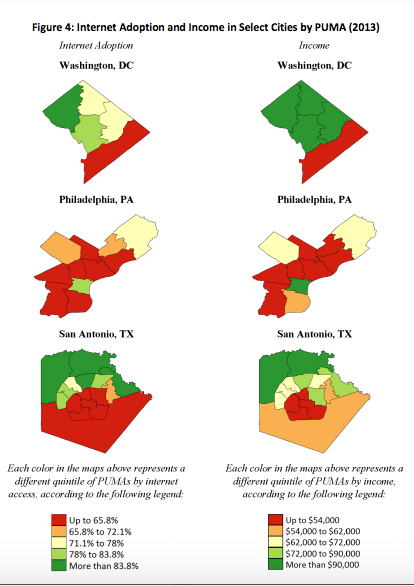
The United States is supposed to set the standard for under developed nations, however, the U.S still has problems of its own when it comes to disparities. The lack of ICTs directly correlates with lower income. This is demonstrated in the image above from https://www.whitehouse.gov/sites/default/files/wh_digital_divide_issue_brief.pdf 

This image highlights the fact that the specific areas in cities and towns with low income rates, also have low internet rates. This is a nationwide phenomenon, therefore, it is areas of low income that most need to be targeted when trying to expand ICT access.

Moreover, the the issue transcends just access to ICTs. The quality of said access is important. What point is there to having an internet router, if the connect does not work.

In regards to worldwide access to ICTs, The MacBride Commission report centered on the disparities between developing and developed countries. This report discusses the lack of democratization in ICTs in some nations.

It must be noted that the two reports mentioned are rather outdated. But, unfortunately, many of the issues outlined in the reports are still problems today.

Digital Divides

The digital divide problem strongly relates to last week’s topic regarding rapid communication technologies.  It is a problem we see mainly in poor rural areas and economically depressed inner cities.  The digital divide refers to the gap in access to communication technologies and the internet, and this is a problem many development practitioners and multinational organizations have had to deal with.  This is because it’s been widely accepted that, for development to occur, this gap needs to close.

Many argue that the world got along just fine before the digital age.  This may be true, but we have now reached an era where these modern technologies have become seamlessly integrated into every aspect of our lives, and that fact simply cannot be ignored.  People can now finish tasks and achieve goals so much more rapidly, and the exchange of knowledge taking place over these systems is beneficial to many.  That being said, much of the world is being left out of these processes that enhance quality of life since they don’t have access.

It is important to look at the digital divide as a whole, but also through the lens of the different demographics being excluded.  As discussed in other weeks of the class, recognizing the intersectionality of different demographics in development speeds up the process.  We see gaps in the digital divide between different minorities, and also based on gender and economic status, for example.  A lot of people overlook the fact or simply don’t know about how large the digital divide actually is, but we have entered an era where these types of technologies are almost needed to survive.

One of the biggest challenges to getting access for everyone, especially in rural areas, is devising ways to put in the needed infrastructure for such technologies to be usable in the first place.  Many of these areas don’t have electricity, fiberoptic cables, computers, or even roads for deliveries.  There are many things we take for granted and don’t even think about that make access nearly impossible in many excluded areas, so work on this needs to be done from the ground up.

Bridging the Digital Divides

The MacBride Commission Report titled “Many Voices One World” sponsored by UNESCO found that a majority of modern communication problems exist between the global North and South as a result of an imbalance in access to telecommunication technologies and as a result, an imbalance of media (often favoring the North) which then impacts how we perceive the information we have access to. 

In response, the overarching goal of telecommunications policy is to ensure universal service and equal access to affordable telephone service in all communities as well as to ensure all communities are being reached with access to broadband for more and better communication. With digital divides, the issue is not just access to these technologies but also if there is access to broadband (high speed and quality) or to mobile access or just within the home, additional markers of truly equal access. The digital divide is defined by the regional, age, gender, and racial/ethnic divides in access to telecommunication technology. In addition, the divide includes access to broadband vs. narrowband, the knowledge divide regarding ICTs as well as a result of a lack of them, and a skill divide surrounding digital technologies.

This is alarming in that as shown through WSIS and its ancestor-documents, access to good ICTs is crucial for development, especially regarding the increase in access to information that they provide, not just at an economic level but at a social and political level as well. For example, in tying back to education, children with access and the ability to use computers and broadband Internet have an automatic increase in knowledge and accessibility to the world. In response, the main steps that can be taken are training of teachers on how to be able to teach students to use technology while also recognizing that children have skills that they are able to teach their teachers, using technology to build capacity. In an increasingly globalized world and a knowledge-based economy, as UNESCO has worked towards, it is crucial that we level the playing field by closing the digital divide.

Finally, an interesting aspect of closing the digital divide involves learning how to utilize cyberinfrastucture to its fullest potential. When we are able to fully understand and utilize the technology we have access to, we have the opportunity to work in global virtual teams across distance, time zones, and cultures. For inclusive sustainable development, this presents a wealth of opportunities from increased information on disabilities for diagnosis, treatment or coping, to increased collaboration among persons with disabilities as a stakeholder group, allowing for a more cohesive and beneficial representation at UN conferences and as a result, in official documents. As we continue to bridge the divide in a world where our lives are so closely intertwined with the digital, the possibilities are endless and exciting for development and beyond.

Digital Divide(s)

With the revelation of the “missing link” by the Maitland Commission Report, immense concern arose for the staggering differences in access to telecommunications across the United States. This was intensified with the creation of the internet and faster, easier, global communication possibilities. In the late 1990s, the NTIA (National Telecommunications & Information Administration) determined there was a significant division between Americans that use the internet, the “haves,” and those that do not, the “have nots” (“Falling through the Net”). This dichotomy is referred to as the  “digital divide,” but it is not as clear a division between two groups as it may sound. There are evident divides between rural and urban areas, young and old age groups, certain racial and ethnic groups, and variances among education and income level. There are also many different ways in which people may be disadvantaged or unable to participate in the digital world. This can include differences in quality of digital connections and devices, the availability of technical assistance and training, and/or subscription-based content. Currently, the most widely discussed issue within the “digital divide” is the availability of quality access at an affordable cost (“Falling through the Net”). The policy driven programs of the NTIA emphasize this need to expand broadband Internet access and adoption in the United States. This also entails ensuring that the Internet maintains and improves its capabilities for continued innovation and economic growth. Increasing the spectrum of internet users is vital step in addressing and improving many of the nation’s most urgent needs, including education, public safety, and health care. The NTIA also represents the Executive Branch in international telecommunications and information policy activities which is important because the digital divide is not just a domestic issue. Now, it is also increasingly evident that huge  populations all over the world have been excluded from this ever-growing technological era due to inadequate resources and education and that the “digital divide” is actually widening (“Falling through the Net”). This is in part because some areas or countries are substantially more equipped to acquire and benefit from internet use than other developing places, and specific groups within populations require but are deprived of necessary assistance within the digital world.  Consequently, bridging the gap of the “digital divide” is a crucial component of achieving inclusive sustainable development and would help create greater economic equality, social mobility, informational capabilities,  and development as defined by Amartya Sen.

The Digital Divide

The concept of a digital divide is the unequal access to information and communicative technologies (ICT’s) based on economic or social factors. Digital divides can manifest in many ways and for many reasons. For some their access to ICT’s is limited due to the lack of infrastructure that supports it. If the government cannot put in place the necessary infrastructure to support internet connection or even phone lines it is incredibly difficult for citizens to find ways to access these opportunities without traveling long distances. This issue is one that I have run across in my project about the arctic indigenous people. Many of the arctic groups live in extraordinarily remote areas in the cold north that their respective states have not spent any time developing. They have limited access to resources in general but almost no access to internet connections. This makes communication across long distances difficulty and isolates them even further. We live in a digital age where information on current events and political processes can mostly be accessed digitally. In order to stay connected to the modern world and current events indigenous groups need to be afforded the same access to ICT’s in order to develop at the same rate.


The Digital divide may also result from economic factors. While the government may not be able to afford the infrastructure to increase access to technology, the people themselves may be excluded from ICT’s based on economic inequalities. Even among developed states there are many people who cannot afford a home computer or to pay companies for internet access. They are forced to use public means to access technology in the same way as others whether through the public library, at school, or more.


One of the central issues with the Digital Divide is the general ideology surrounding technology. For many years technology has been treated as a luxury, something that one should only have if they have the disposable income. Technology connects us to our entertainment and other leisure activities. But technological innovation in recent decades has made technology essential to surviving in our society. People cannot continue to treat technology as something only for the privileged. ICT’s must be spread to people of all statuses if we are ever to be on equal footing. As long as the privileged continue to have greater access to resources that make them money, they will continue to get richer. Meanwhile the developing world will be left still struggling to access technology in a post-industrialized world and be unable to advance. These disparities need to be reduced as quickly as possible and through global partnerships. The Maitland Commission Report advocates for integrating technology into developing communities at affordable rates. More global partnerships are springing up to ensure equal access to ICT’s for all.


Digital Divides

In 1980 the United Nations Educational, Scientific, and Cultural Organization (UNESCO) published “Many Voices One World” – known as the MacBride report written by the International Commission for the Study of Communication Problems. In short, this report aimed to analyze communication problems modern societies face and offer suggestions on how these problems could be diminished to further peace and human development. The report highlighted main functions of communication (p. 18):

    1. Spreading information
    2. Helping people be effective members of society
    3. Fostering individual and community activities
    4. Promoting debate and discussion,
    5. Fostering intellectual development
    6. Disseminating cultural and artistic products
    7. Entertainment
    8. Ensuring all persons, groups, and national have access to vital information

In relation to sustainable development, function 8 – ensuring equal access to information – is especially important. As the MacBride report suggests, there is a rapidly growing global inequality between those who have access to technology and communication systems and those who do not. This often falls long lines between the global north and global south. As Amanda pointed out in her post, in 2013 a staggering 1.2 billion people did not have access to electricity with 95% of those without electricity living in Saharan Africa and Asia. Amanda also pointed out that, according to the UN Broadband Commission, 57% of the world’s population does not have steady access to the internet.

On a domestic level in the United States, these inequalities exist as well. According to the National Telecommunications and Information Administration’s (NTIA) report “Falling Through the Net: Defining the Digital Divide,” minority and rural poor populations have less access to the internet than the white and urban affluent population. For example according to the NTIA, urban households with an annual income over $75,000 are 20 times more likely to have access to the internet than rural households and 9 times for likely to have a computer at home (Irving, Chart 1-2). In addition, those who identify as white are more likely to have access to the internet from home than those who identify as Black or HIspanic, regardless of where they live. In sum, NTIA’s report highlights the digital divide in America showing that, even though over time people are becoming more connected, minority groups, those with lower incomes, and rural populations are still lagging far behind.

As our in-class discussion revealed, an inclusive development strategy must incorporate solutions to this digital divide – on both the global and domestic level. This digital divide permeates every asset of society and acts as a hinderance for minority and disenfranchised groups. On the other hand, if closing the digital gap is at the forefront of development, technology can serve as a leveling factor for those groups. For example, with phone service and internet access, a farmer in a remote location can gain access to the market price of produce ensuring they’re making the most profit possible – elevating themselves economically in the long run. In addition, via the internet and other technological advances, persons with disabilities (PWD) may be able to gain an education and participate in society in ways they were previously excluded from. In sum, the digital divide between the technology haves and have nots is a crucial facet of development that is not only irresponsible but detrimental to overlook and must be incorporated into all strategies moving forward.