
Smart Cities, Habitat III and the New Urban Agenda

Smart Cities, Habitat III and the New Urban Agenda by Ines Renique

Urbanization has been growing at exponential speeds, and Habitat III was a recent conference that addressed just that. Cities are growing and changing at levels that often states cannot keep up with. And considering cities make up about half of the worlds population, maintaining quality infrastructure, services and order is fundamental. Moreover a major issue needed to be addressed in order to create smart cities, is that of slums as well. I was recently in Sao Paolo, Brazil, the largest metropolitan city in the world. And there it was shocking to see the stark differences in society. As for example, right next to the most expensive and luxurious shopping mall filled with handbags and shoes costing thousands of dollars, was one of the largest “favelas” in the city.

Situations like these are exactly what was addressed in Habitat III and in the development of smart cities.Habitat III was an inclusive conference that allowed for people from around the world to participate virtually, even though the conference was in Quito, Ecuador. The deliverables from Habitat III would then be the New Urban Agenda.

Furthermore, the representation of many groups is imperative, since all have the “Right to the City”, as cities need to be inclusive. That is why Habitat III sets the agenda for 20 years on inclusive sustainable development of housing/infrastructure. And when doing so, includes major groups in the decision making process, such as indigenous people, local authorities, trade unions, women, children, aging and the elderly, among others. Furthermore, the New Urban Agenda makes 15 references to people with disabilities. And new technologies, such as the app piloted by the IDPP, work to further the inclusion of people with disabilities in new, smart cities.
ICTs and Inclusive Sustainable Development

ICTs and Inclusive Sustainable Development by Ines Renique

WSIS and WSIS+10 are working to narrow the digital divide. Furthermore, resources such as the SDG and WSIS matrix, allow greater access and points of comparison between the two important frameworks.

What I most investigated for my project was, how is that WSIS can promote education in remote areas. What I found was that the WSIS proposals of E-Business and E-Agriculture are taking advantage of ICTs to expand education outreach. As outlined in WSIS Action Line C7,  “E-learning can play an important role in making education accessible at any time and from any location, which will be particularly important for groups with little time and little flexibility to attend remote trainings.”

Many of the WSIS Action Lines, served as inspiration for me when thinking of the deliverable I wanted for my final project. Ultimately what I created was a platform but online and via phone apps that serve for students and teachers to share their thoughts on the education system in Peru.

And much of that project was inspired by the part of the WSIS+10 outcome document that puts its goals simply by saying:

“We reaffirm our common desire and commitment to the WSIS vision to build a people­ centered, inclusive and development ­oriented Information Society, where everyone can create, access, utilize and share information and knowledge, enabling individuals, communities and peoples to achieve their full potential in promoting their sustainable development and improving their quality of life, premised on the purposes and principles of the Charter of the United Nations, and respecting fully and upholding the Universal Declaration of Human Rights.”

While that paragraph is only a small portion of the WSIS+10 document, I see it as the summation of the major idea behind it. Overall advancing the opportunities of people, and ensuring equality through access to ICTs, and ensuring their rights are met. While it sounds idealistic, WSIS+10 then goes into great detail as to how these goals can actually be accomplished. Moreover, as mentioned in other blog posts, accountability from states is essential to uphold the goals outlined.  That is why it was important to follow up on WSIS with WSIS+10, and continue to have task forces committed to promoting the values and conclusions from the WSIS meetings, within their own states.

The Digital Divide

screen-shot-2016-12-09-at-11-19-16-am

The Digital Divide by Ines Renique

Falling Through the Net was a report that meticulously addressed the divide between urban and rural parts of the country, and between access to ICTs. Moreover, my final project greatly focuses on the digital divide, trying to narrow the disparity between the rural and urban parts of Peru.

And while my project is centered internationally, there are many divides within the United States as well. As The White House website explains:

“The benefits of this technological revolution, however,

have not been evenly distributed. Millions of Americans

still do not regularly use a computer, and research shows

that there remain substantial disparities in both Internet

use and the quality of access. This “digital divide” is

concentrated among older, less educated, and less

affluent populations, as well as in rural parts of the

country that tend to have fewer choices and slower

connections.”

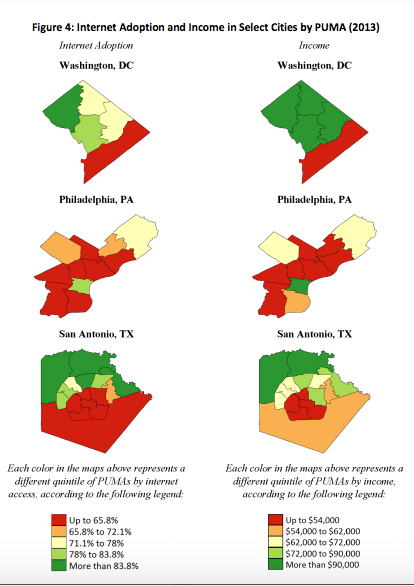
The United States is supposed to set the standard for under developed nations, however, the U.S still has problems of its own when it comes to disparities. The lack of ICTs directly correlates with lower income. This is demonstrated in the image above from https://www.whitehouse.gov/sites/default/files/wh_digital_divide_issue_brief.pdf 

This image highlights the fact that the specific areas in cities and towns with low income rates, also have low internet rates. This is a nationwide phenomenon, therefore, it is areas of low income that most need to be targeted when trying to expand ICT access.

Moreover, the the issue transcends just access to ICTs. The quality of said access is important. What point is there to having an internet router, if the connect does not work.

In regards to worldwide access to ICTs, The MacBride Commission report centered on the disparities between developing and developed countries. This report discusses the lack of democratization in ICTs in some nations.

It must be noted that the two reports mentioned are rather outdated. But, unfortunately, many of the issues outlined in the reports are still problems today.

Global Strategies & Frameworks

I once read about a Norwegian aid agency that decided  to invest in providing a village in Kenya with a fish-freezing plant. Only to find out that the people of this village raise goats. This was a useless investment that has been replicated time and time again. Bringing to question… can international “outsider” organizations impose on other nations? Do other “developed” nations really know what a “developing” nation most needs?

There is a double edged sword oftentimes when it comes to global strategies. And as the Sustainable Development Goals were only put into place a year ago, they Millennium Development Goals are a great point of reference to see what was done right and what was done wrong. Moreover these mistakes and successes can then be inspiration for the remaining years of the Sustainable Development Goals.

Task Teams are a great means of reflection. “The MDGs after 2015: Some

reflections on the possibilities” by Deepak Nayyar’s is a report with insightful points about the post 2015 development agenda.

A key point Nayyar makes, and that i have always argued when it came to the MDGs, is that “the MDGs specify an outcome but do not set out the process which would make it possible to realize the objectives. In other words, the MDGs specify a destination but do not chart the journey” (page 6 of report). Fortunately, the SDGs outline targets in more detail for each goal, which addresses the problem Nayyar points out.

Lastly, he also points of the importance of national context. That based on a country’s norms and mores, propositions and solutions need to be reformulated. Along with that is the importance of governments in making progress advance. Nayyar explains that “In rethinking development, it is important to recognize the relevance of the balance between domestic and external factors and the critical importance of public action.” Achieving that balance and fulfilling the call to action from local communities are fundamental in moving towards higher standards of life.

Intersectionality in Sustainable Development

Intersectionality discusses the fact that different social identities and demographic groups cannot only be looked at in a vacuum; they are interconnected and will always be.  People identify with more than one demographic group, so when looking at how development is affecting certain groups we have to take these nuances into consideration to get a broader understanding of the situation.  Some demographics that are under examination when looking at development include race, gender, class, ethnicity, age, and more.  When looking at the interactions of multiple demographics within an individual or group, there are different outcomes and implications then if we were to only look at one.  For example, a disabled woman will face different challenges than a disabled child.  A disabled child may be excluded from receiving an education, and a disabled woman may not be able to access adequate prenatal care.

The Grand Challenges show us that participants from all these different groups need to be involved in development to help paint a more detailed picture of what the problems are, and how they can best be solved.  Stakeholder groups in international development include: Women, Children and Youth, Indigenous Peoples, Non-Governmental Organizations, Local Authorities, Workers and Trade Unions, Business and Industry, Scientific and Technological Community and Farmers.  These are the nine groups that the UN outlines in the Sustainable Development Goals, although there are many others.  Since the goals were redesigned, there has been a larger focus on paying mind to intersectionality among different stakeholder groups, and in making sure development practitioners have the opportunity to hear from many different viewpoints on what problems should be addressed.

The conceptual basis for my final capstone project on sustainable urban transport in São Paulo had a lot to do with the concept of intersectionality in development.  The recommendations I made came from multiple angles, and did not simply suggest the government expand transportation networks.  Since the issue affected urban residents in many different ways, I made recommendations that would also indirectly fix the problems seen in the city to fill in the gaps where simply building more public transit wouldn’t fix the issue.

Inclusive Education

Inclusive education is another grand challenge international development practitioners have grappled with for a long time, and universal primary education is one of the top concerns or goals to achieve for the Sustainable Development Goals.  When talking about inclusive education, a main problem we see is students with disabilities being excluded from the classroom environment.  There are many different reasons behind this. Oftentimes, people say they will promote disability-inclusive education, but it is much more difficult to do in practice, and much less common.

This can be for cultural reasons.  In many countries, students with mental or physical disabilities are stigmatized for their condition.  This certainly happens in the United States, but we have stronger protections in place for ensuring that students of different backgrounds and abilities are included, relatively speaking.  The cultural stigma of someone having a disability will lead schools to say they cannot have that student in the classroom.

Another cause behind this problem is the extremely daunting financial and professional burden of ensuring that every student, regardless of level of ability, has a seat at the table of education.  It can be extremely costly to get professionals who are trained in working with students with disabilities, and to purchase appropriate equipment and tools that may be needed for a disabled student to have the same level of success as a student who does not have a disability.  It can also be costly, for example, to make an educational facility accessible to a student with a physical disability.  These may mean building wheelchair ramps or installing elevators, which many schools to not have the funds to put in.

As previously discussed, the Millennial Development Goals did not mention these issues enough, but the CRPD has been working hard to increase the rights of people with disabilities.  The cultural stigma is tough to combat if it is so deeply ingrained in the cultural fabric of a country, but the CRPD and the new SDGs recognize the need to combat the issue from a cultural standpoint and a financial one.  Students with physical and mental disabilities have unique problems, and the tactics used also need to be tailored to the country of operation due to cultural reasons.  That way, the outcome can be as effective as possible.

Inclusive Cities, Habitat III, the New Urban Agenda

The United Nations had their conference on housing and sustainable urban development in Quito this October, which had the aim of discussing how to improve urban development in cities around the world.  The New Urban Agenda outlines the next steps with which to tackle the Grand Challenge of sustainable urban development.  This is an extremely important issue, especially when we consider the number of people that are moving from rural to urban areas every year.  Urban areas are exploding in size, and it is crucial that we properly manage them.  IF poorly managed, these urban centers could have detrimental effects on society and on the environment.  Managing this growth is so important, and in fact, by the year 2050, the number of people living in urban areas will double.

Urban development affects every aspect of a person’s daily life, from education to health care, economy, food security, and sanitation, just to name a few.  The ideas laid out in this Urban Agenda have a lot to do with my own capstone project, which was about sustainable urban transport in São Paulo, Brazil.  Public transportation is one of the main challenges that hose focusing on improving urban sustainability focus on.  That’s mainly because public transportation is in many ways the backbone of an urban center, and is what allows a city to develop and thrive.  Half the battle of development is providing access to the different centers of urban activity, like schools, the workplace, hospitals, and more.  Without access to these places, or with poor urban transport infrastructure where commutes to these places can take hours, one cannot live a sustainable and healthy lifestyle, and more importantly, it makes it more difficult for everyone to contribute their skills and talents to the development of the city.

There are many different ways to improve urban transport, whether that be through actual construction of more public transportation networks, or through restructuring new urban development around pre-existing transit stations to increase accessibility (especially for the urban poor, who are the most often excluded from urban activity.)

Multistakeholder Global Governance

Internet governance is a sticky issue, because it is used in every corner of the world and not directly controlled by any one specific entity.  The internet is a public good where information is freely shared.  While the internet was invented in the United States and originally began as a research project done by our military, it has spread to be used worldwide.

In 2005, the WSIS (World Summit on the Information Society) created the concept of internet governance.  Since almost everyone is affected by these decisions, WSIS took a multistakeholder approach to their internet governance and encouraged all to be involved.  Some stakeholders in decisions that are made about the internet include individuals, schools, businesses, and many others.

The Internet Governance Forum was created to be an outlet for voices and opinions of stakeholders to be heard, and for informed decisions to be made.  While governing a free-flow of information is a daunting task, creating this outlet for input from many different groups has helped the situation.

Another important group is the Internet Corporation for Assigned Names and Numbers (ICANN).  This group’s main goal is more administrative in nature, and a common critique with the group is there isn’t a strong enough focus there on international development through the internet.  However, their main objective is the run the technical side of the web, and do things like assign domain names.

In my opinion, having multiple organized groups that administer the internet and monitor its usage allows everyone to benefit, because each of the groups keeps the others accountable for their actions and keeps everyone’s needs in mind.

Efficacy of Global frameworks

We’ve talked a lot about global frameworks as major steps towards sustainable development. Mobilization of multiple high level political actors is integral to successfully changing the world. Global frameworks keep powerful states and organizations engaged in the sustainable development process and demonstrate to the world that it is an issue that is being taken seriously and states want to see progress done.  However, frameworks are only solutions if they are actually working. A large problem with international law and policy is that there are no legal means to enforce cooperation. International law is really just an agreed upon code of conduct, which no country has the true power to enforce other than through coercion. There are no world police to arrest violators of international law, that would be ridiculous. Global frameworks like the Sustainable Development Goals and the United Nations Declaration of Human Rights are signed and ratified by countries, but how do we know if requirements are being met or if they are even effective? The Millennium Development Goals, which came into effect in 2000 were supposed to be met by the year 2015.  For the reasons outlined above, their success was very limited. The goals were not legally binding to any country, and though many countries were on the right track, the goals ultimately were not effective enough. For this reason the follow up goals, the SDG’s, were far more detailed on how goals were to be met and provided specific targets and ways to operationalize sustainability. Though frameworks are not binding, there are ways to facilitate cooperation  and participation among states.


Having a multitude of countries signed on to the same framework makes them more likely to be followed. First and foremost is for the prestige and the social pressure to do the right thing. A sort of “peer pressure” system occurs where major states, particularly in the Western world, feel obligated to promote values of peace and sustainability in order to fit in with the progressive mentality that has become the norm. If a powerful state deviates from the norm it shows a lack of willingness to cooperate at a global level, which may make other states hesitate to work with said state. The integration of morality into politics plays a big role in the success of sustainable development initiatives. Moral obligations force states to commit to change. If we looked at sustainable development from a “realist” relative gains scenario, states would gladly let other states fail in order to increase their own success. However, globalization has connected all states together and introduced some semblance of morality into politics that makes it in a countries best interest to develop the world sustainably

Multistakeholder Internet Governance

Internet governance is an issue growing in importance and it will continue to grow as the internet becomes the primary means by which people communicate. The internet is a method for sharing information that exists transnationally. How do policy makers and interested parties regulate a mechanism of communication that has no physical form? Internet governance is the tricky development of institutions, procedures, and rules that regulate how the internet is used across the world. One of the first questions is who gets to be involved in the process of governing the internet?

There are a variety of stakeholders. First and foremost are states, as they regulate most global interactions and must preserve the rule of law, even over the internet. Other stakeholders would be the corporations and businesses that benefit most from internet traffic and usage. Technology and information companies have a major stake in the successful regulation of the internet and achieving their goals without being restricted. The people themselves are major stakeholders as they are the average users who depend on the internet for daily use.

Internet governance plays a major role in sustainable development in terms of providing equal access to information for all. Without government regulation, the corporations who provide access to information and communicative technologies could pick and choose recipients based on whoever can pay more. While this trend already exists to some degree, government regulation ensures that corporations cannot monopolize internet access. Equal access to the internet is essential for developing communities to communicate effectively, encourage investment, build industry, and strengthen education.

There a variety of platforms and forums that promote and facilitate discussion on internet governance and how to manage it in the future. Netmundial was a meeting for the various stakeholders in internet governance to come together and discuss ideas that took place in Brazil in 2014. The meeting placed states and other international multistakeholders. The focus of the meeting was to create balance among the various stakeholders and foster open communication between all of the players. There is also the Internet Governance Forum, which is a multistakeholder platform that encourages discussion regarding public policy issues and the internet.