
Sen’s Theory Toward Inclusive Development

Development is a loaded term, difficult to define in one finely packaged sentence. Traditionally (and wrongly), the picture that comes to mind with “development” is a cross-comparison, one side in a remote village with no running water, children working the fields rather than attending schools, etc. with the other side taking the shape of a large city, covered in high-rise buildings, cars crowding the streets, the latest mobile technologies in everyone’s hands. In the past, “development” was seen as a mission, something the picture on the right needed to intervene and help the picture on the left achieve. I recall being guilty of this myself, even. In a World Studies course in middle school, a woman came to speak to us about Africa as a continent. She showed us a series of pictures, some of naked children, wild animals, women with water in jugs on their heads, and small huts and some of tall buildings, bustling city centers, and highway systems. She asked us “which of these photographs are of Africa?” and we all chose those that seemed to fit our definition of “underdeveloped,” a notion that she quickly turned over on its head.

Much like this guest speaker did for me (and I am so grateful to her that she did), Amartya Sen has done for development as a concept on a global scale. In Development as Freedom, Sen has changed the discourse on development from the “developed” saving or fixing the “underdeveloped” with an end goal of increased income to an understanding of freedoms and unfreedoms. Thanks to Sen, we know that it is an unfreedom for people and entire countries to be left out of the discussion on what makes them “developed” with countries that claim to be already developed making all of the rules.

He defines development as discourse and more importantly, development as freedom, noting that it goes beyond income and applies to freedoms as the opportunities and choices that exist for people. These choices may included where you live and who you live with, what type of transportation you take, where you go to school, what you study in college, and what career you will have.

In turning our previous notions of development on its head, Sen acknowledges that by these standards, some “developed” countries are not truly developed at all and sets the standard for inclusive and sustainable development. As we move from the Millennium Development Goals to the SDGs to the CRPD, WSIS, and Habitat III and the NUA, it is exciting to see the impact a theory of inclusive development has on the progress we are making and the lens through which we frame these goals and their results.
ICT’s and Sustainable Development

ICT’s are crucial for the success of sustainable development because they aid the technological advances that are necessary in a community. Without access to telephones in the 1980’s, The Missing Link report clearly shows deficits for communities that lack that technology. Without the same access to computers in urban areas, for elderly people, and low income households, the Falling Through the Net Report in 1995 showed the inequalities that the lack of ICT’s can maintain. I had never considered the importance of technology and its role in increasing development for everyone. The Digital Divide is a phenomenon that is still affecting communities all over the world. Without the proper access to broadband, cellphones or reliable service, people are continuing to be left behind.

I am particularly interested in the digital divide in remote and rural areas. Over 70% of the world’s PWD population lives in rural areas, so how do we ensure that they are receiving the access they need to ICT’s? I am still wrestling with the best way to increase inclusion for people in rural areas and especially PWD. Will service be provided most effectively through the government or the private sector? With the push for privatization and liberalization within this field, I am hesitant to believe that the private sector alone will solve the digital divide. Like we discussed in class, what incentives do private investors have to expand their services to rural and remote areas? If more money is to be made in the densely populated areas, how do we ensure access to technology for those most in need of their services?

I also think that total government monopoly would be a mistake. As we have seen in the past with large State Owned Enterprises (SOE’s) in China and Korea, they often become expensive to maintain and inefficient to sustain. I think that the 2000 Falling Through the Net recommendations provide a great balance between the two sectors. With strong government regulations and tax incentives, I think that companies could be persuaded to invest in expanding their services to rural and remote areas. This would encourage the private sector to innovatively come up with cost effective ways to expand their business while also relieving the state of these large, expensive enterprises.

Whatever tactics country’s employ, it is imperative that they do so quickly and efficiently. As the world becomes more and more dependent on ICT’s for business, trade, e-commerce, banking, investments, and personal connections, marginalized groups in rural and remote areas are being further disadvantaged. If ICT’s development in these communities increased, I think the development field would see a huge increase in agency and capability for these populations. They would be able to check the global prices of their goods, engage in education, finance their own businesses and so much more without relying on others.

ICTs and Sustainable Development

In recent years, ICTs (information and communications technology) have often been thought of as the key to sustainable and inclusive development, both in rural and in growing urban areas. ICT is a broad term that encompasses a variety of different technologies. However, in the context of development and inclusive development, ICTs generally serve to improve accessibility and improve inclusivity within countries. The WISIS +10 meeting (World Summit on the Information Society) in December of 2015 and the corresponding WISIS +10 outcome matrix explored how ICTs could be used to achieve sustainable, inclusive development. The WISIS +10 matrix found relevant WISIS action lines within all of the Sustainable Development Goals (SDGs). This demonstrates the widespread depth and application of ICTs and the developmental process.

However, the study of the role of ICTs in development began far earlier than 2015. The Maitland Commission, published a report titled, “The Missing Link” in 1984 explored the role that telecommunications played in development and the inequities in access to telecommunications that existed. It was published by the International Telecommunication Union. This report is largely viewed as an important step in understanding the relationship between ICTs and development. The report, “Falling Through The Net” published in 1995, continued to build upon the ideas introduced within the Maitland Report through internet accessibility. It also laid the groundwork for future analysis and discussion on the role ICTs in development including the WISIS +10 meeting.

ICT are and should be an inarguable part of sustainable, inclusive development. As was explored in the previous class and blog post, ICTs are essential to the creation of “smart cities.” Smart city initiatives, as outlined in the New Urban Agenda (NUA), are key to successful, inclusive development. Nowhere are ICTS more applicable than in the ever-expanding urban areas throughout the world. However, important steps must be taken to ensuring that ICTs and many of the recourses that they seek to increase access to. As is explored in the Maitland Report, there are often access divides within location and incomes. This phenomenon was explored further in the report further in the report titled, “Falling Through the Net.” However, since the publication of the Maitland Report in 1984, a great number of initiatives have been implemented to try to reduce these gaps. While these initiatives have been met with varying degrees of success the expansion of ICTs throughout the world is undeniable. Because of this steep increase, it can be anticipate that their expansion should continue to increase. However, the inclusive distribution of ITCs and the recourses that they help to access will be much harder to achieve.

MDG’s, SDG’s, the HLPF and Persons with Disabilities

The Sustainable Development Goals, an improvement on the Millennium Development Goals, are a set of seventeen goals that address the grand challenges our world society. These goals include poverty eradication, inclusive cities, zero hunger, affordable and clean energy, clean water and sanitation, good health and well-being, quality education, etc. Because monitoring and implementation proved to be such a pertinent issue with the Millennium Development Goals, additional measures were taken for the implementation of the Sustainable Development Goals. In the 2030 Agenda for Sustainable Development, each of seventeen goals has a target and indicator attached to it. The targets and indicators are meant to serve as a follow-up and review mechanism for the implementation of the 2030 Agenda. The targets and indicators of each goal allow stakeholders to better understand steps needed to achieve these goals and allows for increased accountability of stakeholders. While the Sustainable Development Goals are an improvement on the Millennium Development Goals, the SDG’s still face large challenges.

The High-Level Political Forum (HLPF) was created to act as a governing body over the States. The HLPF acts as a body that oversees States and ensures that States are participating fully and taking steps toward achieving the SDG’s. It is important to note that the HLPF prides itself on being inclusive, however, there are many barriers in place that make the HLPF rather exclusive. In order to participate at the HLPF, you must be a representative of a member state or accredited by ECOSOC to participate. If you are not a representative of a member state, participation at the HLPF is limited to the participation of the nine major groups. These major groups include women, children, farmers, indigenous people, local authorities, businesses, civil society, and workers and trade unions. This is increasingly challenging because key stakeholders are left out of the conversation. For example, persons with disabilities do not constitute a major group and therefore do not have direct access to the HLPF. Groups that are not included in the major groups framework are unable to make recommendations, submit documents, attend meetings, access official information and documents, and organize round tables related to the implementation of the SDG’s. This is problematic because key voices and expertise are left behind.

Specifically, in regards to persons with disabilities, while the SDG’s did improve by including 11 explicit references to persons with disabilities, the highly politicized mechanisms in place for implementation of the SDG’s falls short of ensuring that these explicit references will actually be implemented. The HLPF should follow suit of the Third UN World Conference of Disaster Risk Reduction (WCDRR) that took place in Sendai, Japan. This conference was the first conference that was not only accessible to both participants and speakers with disabilities, but also allowed for a tenth major group to participate – persons with disabilities. It is essential that the HLPF incorporate persons with disabilities because they are the experts in this field – they are the only ones who can truly speak to the challenges they face and the importance of incorporating these challenges into the movement toward inclusive sustainable development.


Digital “access” Divide

When I think of the digital divide, the first word that comes to mind is “access.” The digital divide refers to the existing gap between those who can access the internet and those who can’t. Internet access is one of the many resource that people in industrially developed areas take for granted. I think I can speak for my fellow college students (and probably most of our parents) when I say we get frustrated with slow internet connection – let alone no connection at all! We rely on the internet to engage with our community. Access to this form of communication has become a lifeline to the rest of the world – or at least that’s how the people see it who have used it.

Falling through the Net is one of the key documents that addresses the digital divide. In Part II, the authors focus on three main aspects of internet access and usage. Two are related to where and how the internet is accessed. Then, the final area focuses on how people use the internet. I venture to say that most people in industrially developed countries rarely have to consider the first two areas. We can connect to wireless, broadband internet from university campuses, our homes, office buildings, and even many public spaces. Accessibility is something that we take for granted – and this document forces its audience to consider how difficult it is for people in less developed regions to access internet.

Furthermore, whether the internet is accessed via phone or computer does not normally make much of a difference for those of us in the industrially developed world. We know that if for some reason we cannot access the internet through our computer, we can use our phone. Likewise, if we can’t access the internet at work, we can access it at home or any number of public places. It is important to point out that Falling through the Net reports that most people who access the internet outside of their homes do so through work. This says a lot about what we as a global society use internet access for. We not only use the internet for communication, but the nature of the communication has other societal byproducts. To continue this point, Macbride Commission Report argues that it would be shortsighted to see technological advancements as merely technological (78). The reason I am relating these two points is to demonstrate how central the internet is to our work life. It is not only a milestone in regards to technological advancements, but also in regards to economic and social connections.

Development Theory

What do we mean when we say that a person or a group or a country is better off? This complex question drove Amaryta Sen to write Development As Freedom, in which Sen tackles the issue of development. Unlike my fellow classmates, development was not an area that I focused on during my academic studies. As such, Development As Freedom was my introduction to development theory. Development is a multi-disciplinary field that is convoluted by a myriad of perspectives as to what constitutes development of a nation. Prior to Sen, development was largely measured by economic growth. This idea of development as a measure of economic prosperity is culminated in Why Nations Fail. In Why Nations Fail, Acemoglu and Robinson address development in regards to economic growth of a nation and the inclusivity of the institutions of a nation. However, in Development As Freedom, Sen challenges this predominate view by claiming that money is not a measure of all things. Instead, Sen argues that development is the process of expanding human freedoms. Sen focused on the concept of freedom, rather than the means to achieving freedom. He believes that freedoms are restricted by social, political, and economic opportunity. Sen asserts “development consists of the removal of various types of unfreedoms that leave people with little choice and the opportunity of exercising their reasoned agency.” Sen’s assertion led to a critical paradigm shift in the field of development that focuses on the expansion of individual freedom as the primary end and primary means of development.

In International Development Studies, Sumner and Tribe address the three inter-related views on development including: (1) the long-term process of structural change in the international system, (2) short to medium-term process, and (3) development as a discourse. Contextually, these inter-related views on development and the paradigm shift in the field of development brought about the discourse of inclusive sustainable development and more importantly, disability inclusive development. The idea of development as a means of expanding freedoms is especially challenging when viewed from the perspective of persons with disabilities. There are over one million individuals in our world that face a myriad of unfreedoms because of their disability. Inclusive sustainable development practices aim to tackle these unfreedoms. Specifically, efforts focused on disability inclusive development are culminated in the Convention on the Rights of Persons with Disabilities (CRPD).

Upon my introduction to development theory, the idea of freedom as the primary end and the primary means of development, was inspiring. Sen highlights the importance of freedoms that allow people to help themselves and influence the world; this inspired me to choose my capstone topic focused on disaster risk management at the community level. My capstone project, when viewed from a larger context, is an attempt to reduce the unfreedoms that communities face in building resilience to natural disaster. It highlights the importance of freedoms that allow communities to help themselves in the face of natural disaster.

Viewing development as a means to expand human freedoms is essential to achieving inclusive sustainable development.

Smart Cities, Habitat III and the New Urban Agenda

Smart Cities, Habitat III and the New Urban Agenda by Ines Renique

Urbanization has been growing at exponential speeds, and Habitat III was a recent conference that addressed just that. Cities are growing and changing at levels that often states cannot keep up with. And considering cities make up about half of the worlds population, maintaining quality infrastructure, services and order is fundamental. Moreover a major issue needed to be addressed in order to create smart cities, is that of slums as well. I was recently in Sao Paolo, Brazil, the largest metropolitan city in the world. And there it was shocking to see the stark differences in society. As for example, right next to the most expensive and luxurious shopping mall filled with handbags and shoes costing thousands of dollars, was one of the largest “favelas” in the city.

Situations like these are exactly what was addressed in Habitat III and in the development of smart cities.Habitat III was an inclusive conference that allowed for people from around the world to participate virtually, even though the conference was in Quito, Ecuador. The deliverables from Habitat III would then be the New Urban Agenda.

Furthermore, the representation of many groups is imperative, since all have the “Right to the City”, as cities need to be inclusive. That is why Habitat III sets the agenda for 20 years on inclusive sustainable development of housing/infrastructure. And when doing so, includes major groups in the decision making process, such as indigenous people, local authorities, trade unions, women, children, aging and the elderly, among others. Furthermore, the New Urban Agenda makes 15 references to people with disabilities. And new technologies, such as the app piloted by the IDPP, work to further the inclusion of people with disabilities in new, smart cities.

ICTs and Inclusive Sustainable Development

ICTs and Inclusive Sustainable Development by Ines Renique

WSIS and WSIS+10 are working to narrow the digital divide. Furthermore, resources such as the SDG and WSIS matrix, allow greater access and points of comparison between the two important frameworks.

What I most investigated for my project was, how is that WSIS can promote education in remote areas. What I found was that the WSIS proposals of E-Business and E-Agriculture are taking advantage of ICTs to expand education outreach. As outlined in WSIS Action Line C7,  “E-learning can play an important role in making education accessible at any time and from any location, which will be particularly important for groups with little time and little flexibility to attend remote trainings.”

Many of the WSIS Action Lines, served as inspiration for me when thinking of the deliverable I wanted for my final project. Ultimately what I created was a platform but online and via phone apps that serve for students and teachers to share their thoughts on the education system in Peru.

And much of that project was inspired by the part of the WSIS+10 outcome document that puts its goals simply by saying:

“We reaffirm our common desire and commitment to the WSIS vision to build a people­ centered, inclusive and development ­oriented Information Society, where everyone can create, access, utilize and share information and knowledge, enabling individuals, communities and peoples to achieve their full potential in promoting their sustainable development and improving their quality of life, premised on the purposes and principles of the Charter of the United Nations, and respecting fully and upholding the Universal Declaration of Human Rights.”

While that paragraph is only a small portion of the WSIS+10 document, I see it as the summation of the major idea behind it. Overall advancing the opportunities of people, and ensuring equality through access to ICTs, and ensuring their rights are met. While it sounds idealistic, WSIS+10 then goes into great detail as to how these goals can actually be accomplished. Moreover, as mentioned in other blog posts, accountability from states is essential to uphold the goals outlined.  That is why it was important to follow up on WSIS with WSIS+10, and continue to have task forces committed to promoting the values and conclusions from the WSIS meetings, within their own states.

The Digital Divide

screen-shot-2016-12-09-at-11-19-16-am

The Digital Divide by Ines Renique

Falling Through the Net was a report that meticulously addressed the divide between urban and rural parts of the country, and between access to ICTs. Moreover, my final project greatly focuses on the digital divide, trying to narrow the disparity between the rural and urban parts of Peru.

And while my project is centered internationally, there are many divides within the United States as well. As The White House website explains:

“The benefits of this technological revolution, however,

have not been evenly distributed. Millions of Americans

still do not regularly use a computer, and research shows

that there remain substantial disparities in both Internet

use and the quality of access. This “digital divide” is

concentrated among older, less educated, and less

affluent populations, as well as in rural parts of the

country that tend to have fewer choices and slower

connections.”

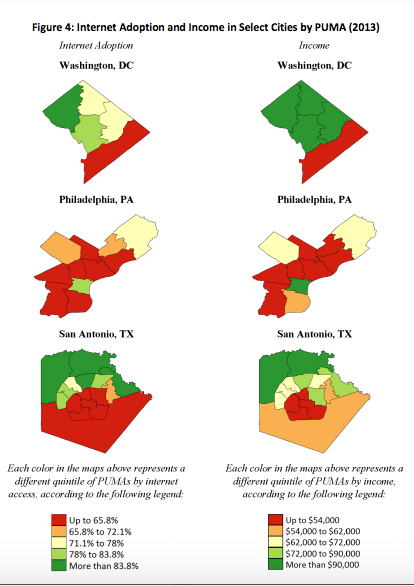
The United States is supposed to set the standard for under developed nations, however, the U.S still has problems of its own when it comes to disparities. The lack of ICTs directly correlates with lower income. This is demonstrated in the image above from https://www.whitehouse.gov/sites/default/files/wh_digital_divide_issue_brief.pdf 

This image highlights the fact that the specific areas in cities and towns with low income rates, also have low internet rates. This is a nationwide phenomenon, therefore, it is areas of low income that most need to be targeted when trying to expand ICT access.

Moreover, the the issue transcends just access to ICTs. The quality of said access is important. What point is there to having an internet router, if the connect does not work.

In regards to worldwide access to ICTs, The MacBride Commission report centered on the disparities between developing and developed countries. This report discusses the lack of democratization in ICTs in some nations.

It must be noted that the two reports mentioned are rather outdated. But, unfortunately, many of the issues outlined in the reports are still problems today.

Stakeholders in the SDGs and HLPF

The Sustainable Development Goals define themselves on the official United Nations website as an official agenda intended to serve as a “plan of action for people, planet and prosperity”. The seventeen Sustainable Development Goals and 169 targets, which the UN has announced, demonstrate the scale and ambition of this new universal Agenda. It also seeks to improve the reach and quality of peace through many kinds of enhanced freedoms. The makers of the Goals note in that eliminating poverty is the “greatest global challenge and an indispensable requirement for sustainable development”. Similarly lofty goals in the Goals are the elimination of violence and bringing perfect access to justice for every person in every country. The Goals seek to build on the Millennium Development Goals and to bring into existence what the MDGs worked for. The Goals advertise themselves are integrated and inseparable in that they balance the three dimensions of sustainable development: the economic, social and environmental.

The Goals count every country as a stakeholder and also frequently refer to “all stakeholders” as an umbrella group. The stakeholders are those entities that will collaborate to implement the SDGs. This implies that even if everyone’s input is not equally heard, everyone will have a voice in the satisfaction of these goals. The meeting of the high-level political forum (HLPF) on sustainable development in 2017 convened under the authority of the Economic and Social Council from Monday, 10 July, to Wednesday, 19 July 2017 as the first attempt to integrate the countless voices that the SDGs purport to need. Many of the other posts on this blog go into considerable depth on the details of the HLPF, so this post will explore a pessimistic, tangentially related idea. The HLPF has scheduled meetings from this year to the year 2030. 2030 is the deadline that the SDGs have given themselves. The HLPF’s official website says that its most frequently employed review mechanism will be to encourage member states to “conduct regular and inclusive reviews of progress at the national and sub-national levels, which are country-led and country-driven” (paragraph 79)”. The site says that these national reviews are expected to serve as a basis for the regular reviews conducted by the (HLPF). As written by the 2030 Agenda, “regular reviews by the HLPF are to be voluntary, state-led, undertaken by both developed and developing countries, and involve multiple stakeholders”. This initially sounds positive, but the intentionally expansive definition of “stakeholders” could allow the accounts and opinions of local-level bureaucrat’s to be the false global perception of a development issue in a remote region.